The Constitutional Anchor: Supreme Court Upholds Birthright Citizenship
By The Blog Source
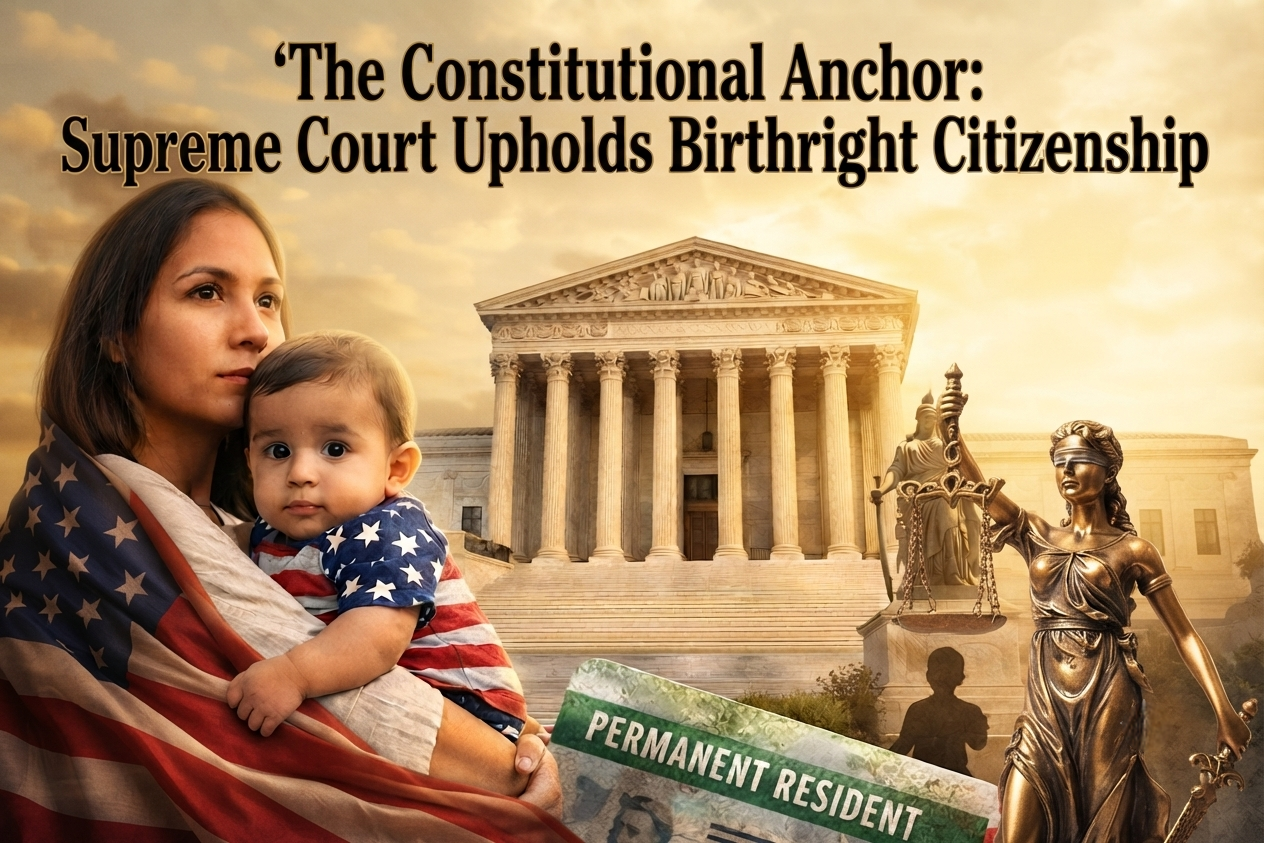
In a landmark decision handed down on June 30, 2026, the Supreme Court of the United States issued its opinion in Trump v. Barbara. The ruling serves as a definitive rebuke to attempts to reshape the meaning of American citizenship through executive action, reaffirming that the Fourteenth Amendment remains the immovable bedrock of the American birthright.
By a decisive margin, the Court struck down Executive Order No. 14160, which had sought to exclude children born in the United States to unauthorized or temporary residents from automatic citizenship.



The Court’s Reasoning: A Simplified Breakdown
The Court’s decision, delivered by Chief Justice John Roberts, relied on a rigorous historical and textual analysis of the Citizenship Clause. The core of the Court's argument can be broken down into three key pillars:
The Plain Text of the Fourteenth Amendment: The Amendment explicitly states that "All persons born or naturalized in the United States, and subject to the jurisdiction thereof, are citizens." The Court held that the phrase "subject to the jurisdiction thereof" refers to the sovereign power of the United States to govern those within its borders. Anyone physically present in the U.S. is subject to its laws, and therefore, their children fall under the protection of this clause.
The Common Law Foundation: The opinion emphasizes that the drafters of the Fourteenth Amendment were operating within the framework of English common law. Under the doctrine of jus soli ("right of the soil"), citizenship was conferred upon birth within a sovereign's territory. The Court noted that the narrow exceptions to this—such as children of foreign diplomats—were well-understood and did not encompass children of individuals present in the country for "business or caprice."
The Binding Precedent of Wong Kim Ark: The Court anchored its ruling in its 1898 decision, United States v. Wong Kim Ark. In that case, the Court held that the Fourteenth Amendment was "declaratory" of the fundamental rule of citizenship by birth. The 2026 Court affirmed that the reasoning in Wong Kim Ark cannot be reconciled with a "domicile" or "lawful status" requirement for parents.

Experience the ultimate restoration of your gut health with Bio-Defense. (Use Promo Code: TrumpWon for Discount.)
Historical Context: From Dred Scott to Reconstruction
To understand the weight of this decision, one must look to the historical trauma that necessitated the Fourteenth Amendment.
Following the Supreme Court’s catastrophic 1857 decision in Dred Scott v. Sandford—which denied citizenship to individuals of African descent—the nation was plunged into Civil War. The Reconstruction Congress sought to permanently codify a universal standard of citizenship that could not be undone by shifting political winds or discriminatory judicial interpretations.
As noted in legal scholarship from the era of the Amendment's drafting, the authors of the Fourteenth Amendment were well aware of existing "unauthorized" populations. By choosing the broad language of "all persons," the Framers intentionally created an inclusive, bright-line rule. They intended to ensure that citizenship was determined by birth on American soil, not by the legal status of one's ancestors.

Start your day with a refreshing glass of Peach Mango Covilyte! Packed with energy, hydration, and a full spectrum of essential vitamins and minerals, it's a delicious way to fuel and protect your body.
The Broader Impact
This ruling brings a measure of legal certainty to a question that has roiled American politics for years. By rejecting the "revisionist" history that attempted to condition citizenship on parental status, the Court has signaled that the constitutional definition of a citizen is not subject to alteration by executive fiat.
While the debate over immigration policy continues, the Court has made it clear that the Fourteenth Amendment serves as a constitutional floor, guaranteeing that the fundamental rights of those born within the United States are beyond the reach of the Executive Branch to revoke.
To conclude the analysis, it is essential to represent the significant legal and policy-based arguments raised by those who oppose the current interpretation of birthright citizenship. While the Supreme Court upheld the policy in Trump v. Barbara, critics continue to emphasize the following points:
Original Intent and the "Jurisdiction" Clause: Opponents argue that the phrase "subject to the jurisdiction thereof" in the Fourteenth Amendment was intended to mean something more than mere physical presence. They contend that the drafters meant "subject to the complete political jurisdiction" of the United States—implying that individuals who owe allegiance to a foreign power, or who are present in the country without legal authorization, fall outside the scope of the citizenship guarantee.
The "Consent of the Governed" Argument: Critics frequently argue that citizenship is a reciprocal relationship between the state and the individual. They contend that the United States cannot unilaterally confer citizenship upon children whose parents have entered the country in violation of federal immigration law, as this undermines the sovereignty of the nation and the rule of law.
Policy Consequences and "Birth Tourism": Beyond the legal interpretation, opponents highlight the societal and economic strain they believe is caused by automatic birthright citizenship. They argue that the policy incentivizes "birth tourism"—where foreign nationals travel to the U.S. solely to secure citizenship for their children—and that it facilitates chain migration, which they claim places an undue burden on public resources and dilutes the political power of existing citizens.
Modernizing Citizenship: Many immigration reform advocates argue that the 1898 precedent of Wong Kim Ark was decided in a different era and fails to account for the modern realities of mass, rapid global travel and the scale of unauthorized immigration. They maintain that a static interpretation of the Fourteenth Amendment prevents the American people, through their elected representatives in Congress, from setting immigration policies that align with current national interests.
For further exploration of the legal arguments and the history of this debate, see the Congressional Research Service analysis and the Council on Foreign Relations overview on the topic.
Join the Inner Circle
To become a vital part of the journey, you can sign up for the Diamond and Silk Monthly Supporter Program. This program allows fans to provide ongoing support while gaining closer access to their latest updates and initiatives.
Where to Follow and Watch
You can find Diamond and Silk’s content and stay updated on the following platforms:
Video & Streaming: Catch their latest broadcasts and appearances on Lindell TV, Rumble, and Diamond and Silk Media.
Social Media & Community: Engage with them directly on Truth Social, VOCL, and ChatDit.
















Artificial intelligence and emerging technologies are rapidly rewriting the rules of the modern classroom.