President Trump Shrinks D.C.’s Bloated Federal Bureaucracy to Its Lowest Levels Since 1966
By The Blog Source
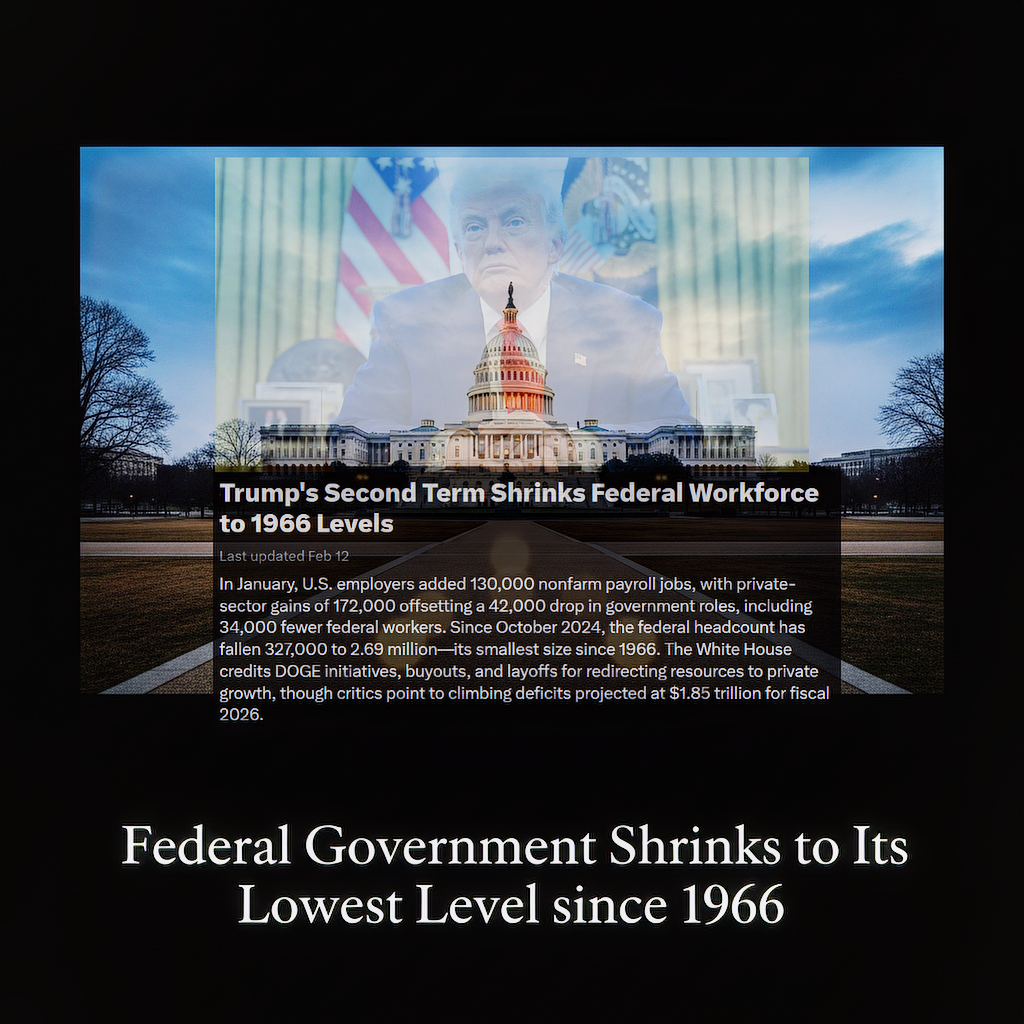
Today, Washington is smaller than it has been for almost 60 years. The federal workforce has decreased to its lowest level since 1966, according to new data, a historic milestone that highlights President Trump's efforts during his second term to control what he has long characterized as an isolated and overgrown bureaucracy.


Updated data from the Office of Personnel Management and the Federal Reserve Bank of St. Louis shows that headcounts have drastically decreased in almost all of the main agencies. The Departments of Education, Agriculture, and Housing and Urban Development have laid off more than 25% of their employees. Whole divisions have become smaller. Offices that used to grow steadily are now running more efficiently.
One notable exception is the Department of Homeland Security. Its employment levels have been relatively stable, which is indicative of the administration's ongoing emphasis on national security and border enforcement despite other federal agencies cutting back.

Experience the ultimate restoration of your gut health with Bio-Defense. (Use Promo Code: TrumpWon for Discount.)
For many years, government jobs were considered permanent because they offered steady income, excellent benefits, and a career path that could last from college to retirement. President Trump said that the model had become complacent when he returned to government. He ran on a platform of reducing the federal government's footprint and making agencies defend their size to taxpayers. According to the most recent data, he has delivered on the promises made during his campaign.

Start your day with a refreshing glass of Peach Mango Covilyte! Packed with energy, hydration, and a full spectrum of essential vitamins and minerals, it's a delicious way to fuel and protect your body.
By characterizing the cuts as a structural makeover rather than a temporary trimming exercise, OPM Director Scott Kupor stated, "This effort ensures taxpayer dollars support a workforce that delivers efficient, responsive, and high-quality services."
Almost immediately after the inauguration, the drawdown started. Buyout offers were made to civilian government employees within days, although they were cautioned that the administration was unable to provide them "complete assurance" that their jobs would be retained. Tens of thousands were approved. Cabinet secretaries were instructed to expedite departures by releasing probationary staff, who are the most recent hires. Researchers, regulators, and tax enforcement staff were impacted by later waves of layoffs that affected organizations like the Internal Revenue Service and the Department of Health and Human Services.
Elon Musk, a wealthy businessman who supported an ambitious efficiency agenda through his Department of Government Efficiency and acted as a senior consultant, supported the early drive. A workforce accustomed to that level of scrutiny was startled when he mandated that workers send weekly letters outlining five specific successes.
The cutbacks, according to supporters, are a long-overdue structural adjustment that will eventually compound. Critics worry that cuts to housing, health care, and tax enforcement may have unintended consequences and wonder if the immediate savings outweigh the extent of the disturbance. The government payroll has been forced down to levels not seen since the Johnson administration, but one thing is now certain. That is a generational change, not a small adjustment, in a place where bureaucratic permanency is the norm.
To join the Diamond and Silk Monthly Supporter Program, visit http://SupportDiamondandSilk.com.
Lindell TV, VOCL, ChatDit, Rumble, TruthSocial, and Diamond and Silk Media are all excellent ways to stay connected with Diamond and Silk.




















Artificial intelligence and emerging technologies are rapidly rewriting the rules of the modern classroom.