Bench Under Fire: Why the DOJ Is Targeting Minnesota Federal Judges Over Press Comments
By The Blog Source
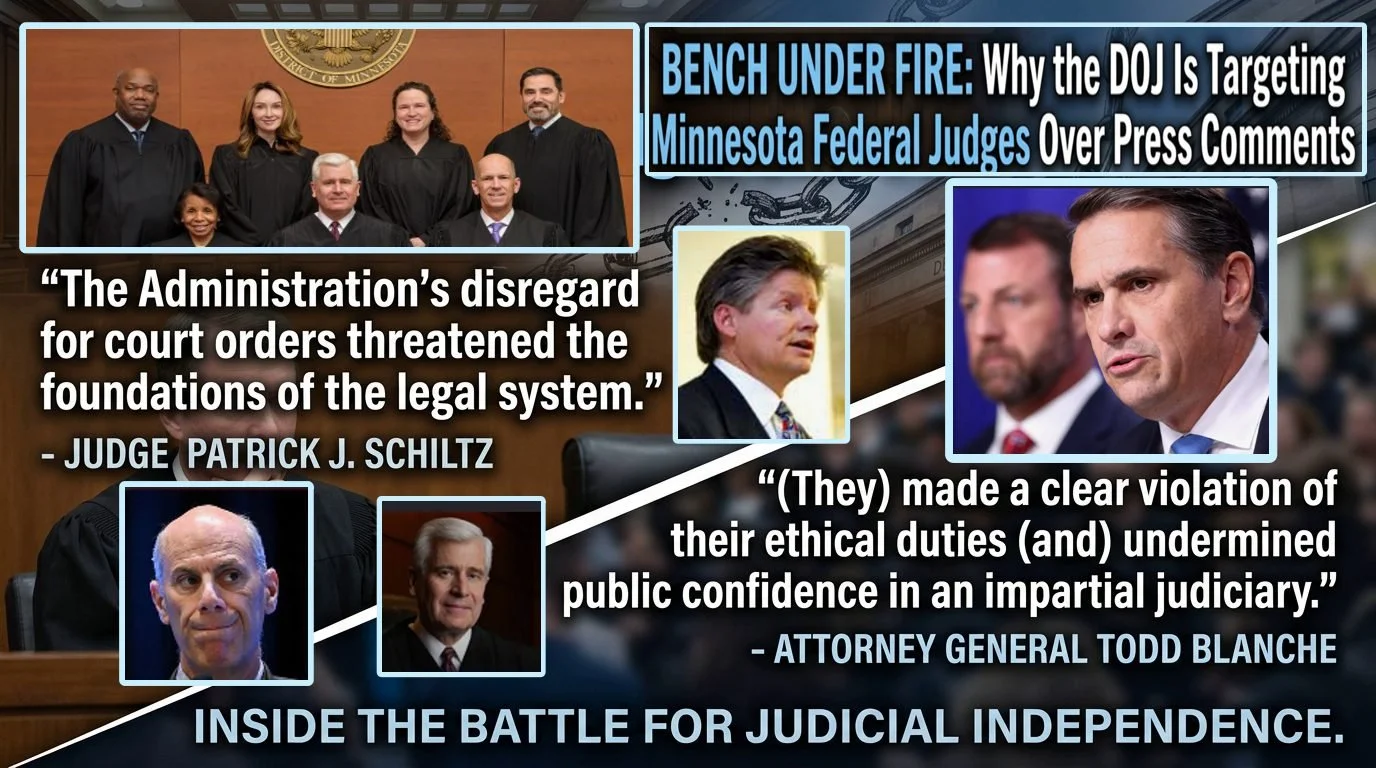
A high-stakes clash between the executive branch and the federal judiciary has erupted into the open.
On September 30, 2026, the United States Department of Justice submitted a formal judicial misconduct complaint to Chief Judge Steven Colloton of the U.S. Court of Appeals for the Eighth Circuit, detailed alongside a public announcement from the DOJ Office of Public Affairs. At the center of the dispute is a series of media interviews given by federal district judges concerning federal immigration operations—interviews the DOJ asserts crossed the line into unethical public advocacy and partisan commentary.



The Spark: A Revelatory Press Interview
The dispute traces directly to a September 17, 2026, article published by the New York Times titled “Trump’s Minnesota Surge Threatened Democracy, Judge Warns.”
According to the filed complaint, U.S. District Judge Patrick J. Schiltz participated in an extensive 90-minute interview reflecting on the political and judicial fallout from federal immigration crackdowns. Former Chief Judge John R. Tunheim and five other judges—comprising six of the seven active judges on the District of Minnesota bench during that period—also spoke with the publication.

Experience the ultimate restoration of your gut health with Bio-Defense. (Use Promo Code: TrumpWon for Discount.)
In the interviews, judges reflected candidly on the logistical and constitutional pressures brought on by federal enforcement:
Judge Schiltz remarked that the administration's actions showed a "disregard for court orders" that "threatened the foundations of the legal system."
Schiltz warned that without adherence to the rule of law, "you have either anarchy or you have authoritarianism. You have Russia or you have China or you have North Korea."
Judge Tunheim publicly commented on immigration arrests, stating: "They weren't arresting, in my view, people who were dangerous criminals on the street."
Key Allegations in the Judicial Misconduct Complaint
The formal complaint argues that these comments violated foundational canons of the Code of Conduct for United States Judges, specifically:
Canon 2A: Mandating that judges act at all times in a manner promoting public confidence in judicial integrity and impartiality.
Canon 3A(6): Strictly prohibiting public commentary on the merits of pending or impending cases across any court until all appeals are exhausted.
The DOJ contends that these statements were far from historical retrospectives, pointing out that several cases related to Operation Metro Surge remain actively litigated. Specifically, the department cited habeas corpus challenges such as Avila v. Blanche—currently pending before the Supreme Court—and ongoing appeals like Velasquez v. Garcia in the Eighth Circuit.
The Department of Justice Reacts
Leadership across the Justice Department condemned the interviews as an unprecedented breach of courtroom neutrality:
Attorney General Todd Blanche stated:
"Seven federal judges in the District of Minnesota talked to the New York Times about cases, some of which are on-going, in a manner that the Department of Justice views as a clear violation of their ethical duties. Their conduct has undermined public confidence in an impartial judiciary in Minnesota."
Acting Deputy Attorney General Trent McCotter argued that judges who "pander to the press about immigration policies" undermine public trust, noting that self-interested publicity compromises courtroom neutrality.
Associate Attorney General Stanley E. Woodward, Jr. asserted that launching public media campaigns on controversial policies compromises the administration of justice and prevents a fair, impartial legal forum.
Demands for Recusal and Official Investigation
Rather than issuing a symbolic rebuke, the DOJ’s complaint outlines specific demands for administrative relief:
Mandatory Recusals: The complaint requests that Judge Schiltz, Judge Tunheim, and the participating judges recuse themselves from all current and future matters involving the Department of Homeland Security (DHS), claiming their public statements reasonably call their impartiality into question.
Circuit-Level Probe: It calls on the Eighth Circuit Judicial Council to appoint a special investigative committee under the Rules for Judicial-Conduct and Judicial-Disability Proceedings to formally investigate the bench's interactions with the press.

Start your day with a refreshing glass of Peach Mango Covilyte! Packed with energy, hydration, and a full spectrum of essential vitamins and minerals, it's a delicious way to fuel and protect your body.
The Constitutional Stakes
This controversy brings to light an enduring constitutional friction point: where does a judge’s responsibility to alert the public to institutional breakdown end, and where does ethical misconduct begin?
When judges take their concerns to national media outlets, they inevitably risk allegations of judicial activism. Conversely, when the executive branch seeks to sideline an entire regional bench from federal agency litigation, it tests the independence of the courts. The Eighth Circuit’s pending review of the complaint will set an important precedent for judicial conduct in an era of heightened political tension.
Join the Conversation: Do judges have a duty to speak out when they believe court orders and constitutional norms are being ignored, or does speaking to the press irreparably damage public confidence in judicial neutrality? Share your thoughts below.
Join the Inner Circle
To become a vital part of the journey, you can sign up for the Diamond and Silk Monthly Supporter Program. This program allows fans to provide ongoing support while gaining closer access to their latest updates and initiatives.
Where to Follow and Watch
You can find Diamond and Silk’s content and stay updated on the following platforms:
Video & Streaming: Catch their latest broadcasts and appearances on Lindell TV, Rumble, and Diamond and Silk Media.
Social Media & Community: Engage with them directly on Truth Social, VOCL, and ChatDit.




















A high-stakes clash between the executive branch and the federal judiciary has erupted into the open.