Summary of Findings: The Michigan Voter Registration Investigation Unclassified Files
By The Blog Source
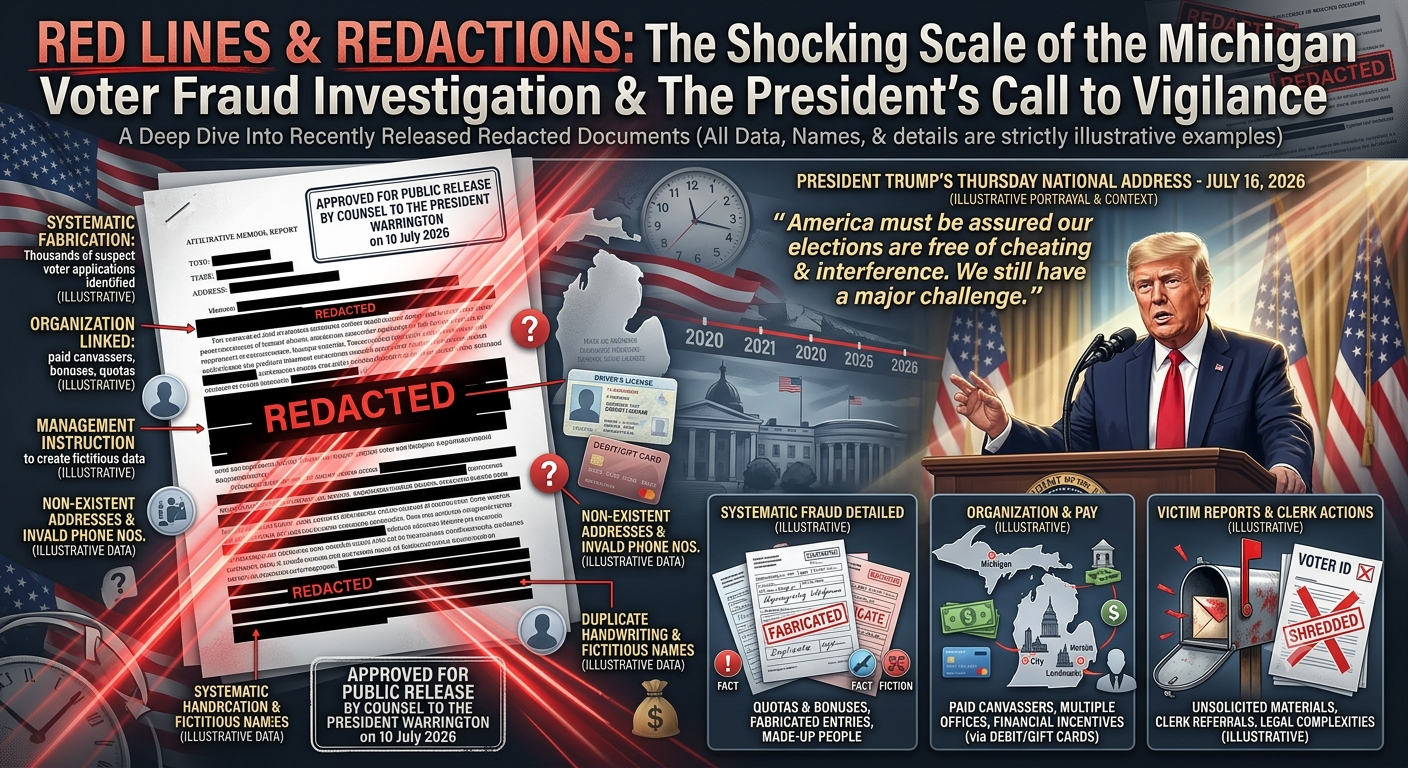
Here is a summary of the findings from the provided FBI documents entitled Michigan Voter Registration Investigation, followed by an editorial article based on these records.
This summarized outline is for the most recent redacted unclassified FBI records, interview memos, and investigation timelines detailing a widespread, organized voter registration fraud scheme in Michigan during the Fall 2020 election cycle.



Key Discoveries:
Orchestrated Forgery: An unnamed organization conducting voter registration drives systematically submitted thousands of fraudulent voter registration applications. In Muskegon alone, the City Clerk’s Office received an estimated 8,000 to 10,000 applications tied to this group, many of which featured the same handwriting, non-existent addresses, and invalid phone numbers.
Explicit Instructions from Management: Multiple canvassers confessed to the FBI that supervisors explicitly instructed them to fabricate voter data. During a meeting of over 100 employees, management picked up blank applications and demonstrated how to make up names, Social Security numbers, dates of birth, and phone numbers to meet daily quotas.
Financial Incentives for Fraud: Canvassers were heavily incentivized to produce volume. Many were paid based on the number of completed applications they submitted or were offered bonuses (via prepaid debit cards) for meeting quotas. Some canvassers allegedly traded marijuana and money for completed forms.
Concrete Proof of Fabrication: When the FBI ran database checks on a sample batch of 107 suspect applications, 91 of the individuals listed did not even exist. Of the 16 real people identified, only four had signatures that matched the ones on the applications.
Real Victims: A Southfield, MI resident reported that after explicitly refusing to register to vote with a canvasser who showed up at her home, she inexplicably received a voter registration ID card and an absentee ballot in the mail (which she promptly shredded).
Bureaucratic Delays and Stalled Justice: The case timeline reveals a four-year struggle between FBI field agents and the Department of Justice’s Public Integrity Section (PIN). Despite confessions and glaring evidence gathered since October 2020, PIN continually delayed authorizing full investigations and handwriting analyses. By July 2024, the USAO declined to prosecute. It was only in October 2024—after congressional inquiries and FOIA requests were mounted—that the USAO stated it was “reconsidering prosecution.”

Experience the ultimate restoration of your gut health with Bio-Defense. (Use Promo Code: TrumpWon for Discount.)
Editorial: Manufactured Voters and Delayed Justice in Michigan
The bedrock of any functioning democracy is the integrity of its elections. But what happens when the very gateway to the ballot box is flooded with fabrications, and the watchdogs take four years to decide if they even want to bark?
Newly released FBI records detailing a massive 2020 voter registration fraud scheme in Michigan offer a chilling glimpse into an industrial-scale forgery operation. More disturbingly, the documents expose a bureaucratic quagmire within the Department of Justice that allowed the perpetrators of this scheme to walk away untouched for years.
In the fall of 2020, a well-funded organization deployed armies of canvassers across Michigan—from Muskegon to Detroit, Flint to Lansing. Their objective was ostensibly civic engagement: registering voters. The reality, however, was a high-pressure, quota-driven operation where integrity was shredded in exchange for prepaid debit cards.
The FBI witness interviews read less like a political thriller and more like the playbook of a disorganized crime syndicate. Canvassers admitted that when they couldn’t meet their daily quotas, supervisors stood in front of rooms of over 100 employees and explicitly instructed them to invent citizens out of thin air. “Make up names. Make up Social Security numbers. Make up dates of birth,” was the directive. The fraud was so rampant that one worker estimated she personally submitted 100 fake applications, noting that “everyone working there was aware it was occurring.”
The numbers back up the confessions. When the Muskegon City Clerk flagged a massive influx of suspicious packages, law enforcement stepped in. Out of an estimated 8,000 to 10,000 applications dumped on Muskegon alone, the red flags were blinding: matching handwriting across distinct forms, bogus addresses, and phantom citizens. In one FBI sample of 107 suspect forms, 85% of the “voters” didn’t even exist in public databases.
And yet, this was not a victimless paper crime. Real Michigan residents were caught in the crossfire. One Southfield voter explicitly turned away a canvasser, refusing to hand over her information or register. Weeks later, an unsolicited voter ID card and an absentee ballot arrived in her mailbox anyway—a terrifying breach of identity and electoral security.
One might assume that armed with signed confessions, a mountain of forged documents, and a clear paper trail, the Department of Justice would move swiftly to dismantle the organization and prosecute the leadership.
One would be wrong.

Start your day with a refreshing glass of Peach Mango Covilyte! Packed with energy, hydration, and a full spectrum of essential vitamins and minerals, it's a delicious way to fuel and protect your body.
The internal case timeline reveals a staggering four-year game of hot potato. While FBI field agents pushed to secure search warrants, conduct handwriting analyses, and interview witnesses, the DOJ’s Public Integrity Section (PIN) dragged its feet. Approvals were stalled. Guidance was delayed. For years, the case was trapped in a purgatory of bureaucratic apathy. In July 2024, the hammer finally dropped: the U.S. Attorney’s Office advised there would be no prosecution.
It took the looming threat of FOIA requests and pressure from state representatives in late 2024 for the DOJ to suddenly begin “reconsidering” its stance.
Election integrity should not require a pressure campaign to enforce. The Michigan case proves that our election infrastructure is vulnerable not just to bad actors looking to make a quick buck but also to the lethargy of the institutions sworn to protect it. If organizations can mass-produce phantom voters without facing the immediate, crushing weight of the law, the deterrent for future fraud is nonexistent.
Justice delayed is justice denied—and when it comes to the voter rolls, it is the American electorate that ultimately pays the price.
Join the Inner Circle
To become a vital part of the journey, you can sign up for the Diamond and Silk Monthly Supporter Program. This program allows fans to provide ongoing support while gaining closer access to their latest updates and initiatives.
Where to Follow and Watch
You can find Diamond and Silk’s content and stay updated on the following platforms:
Video & Streaming: Catch their latest broadcasts and appearances on Lindell TV, Rumble, and Diamond and Silk Media.
Social Media & Community: Engage with them directly on Truth Social, VOCL, and ChatDit.



















Voting is one of the most powerful ways to make your voice heard in national, state, and local elections. But before you can head to the polls and cast your ballot, there’s one crucial step you must take: registering to vote.