Iran Conflict: Legal Water Infrastructure Threat
By The Blog Source
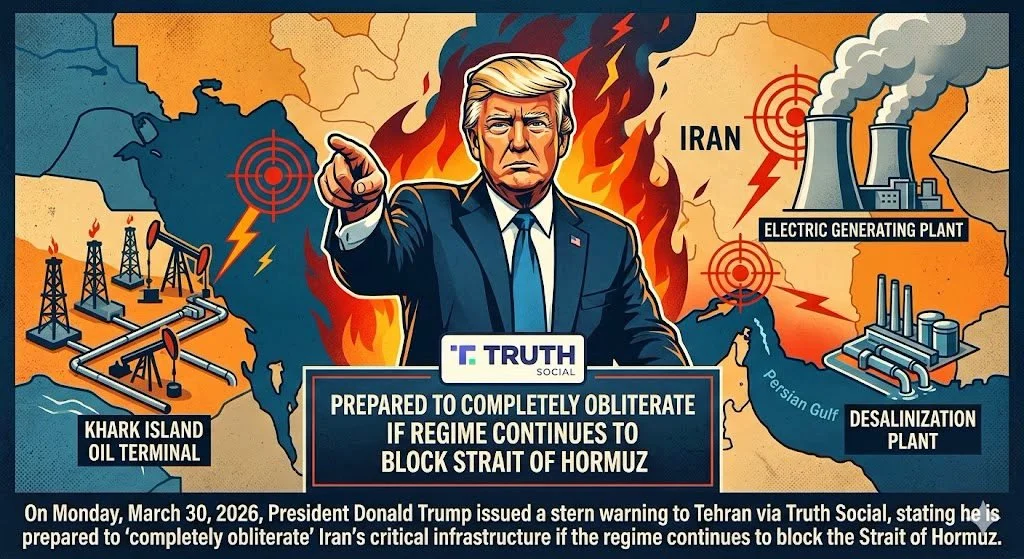
President Trump Threatens "Obliteration" of Iranian Infrastructure
On Monday, March 30, 2026, President Donald Trump issued a stern warning to Tehran via Truth Social, stating he is prepared to "completely obliterate" Iran’s critical infrastructure if the regime continues to block the Strait of Hormuz.
The President's specific targets for potential strikes include the following:
Electric generating plants and oil wells
Kharg Island (the terminal for 90% of Iran's oil exports)
Desalination plants, which supply fresh water to 90 million citizens.
Market and Global Reaction
The conflicting signals—alternating between claims of "great progress" in peace talks and threats of total destruction—caused significant market volatility:
Equities: Dow futures rose 357 points (0.8%) on initial hopes of a deal.
Energy: Brent crude jumped to $115 a barrel, while U.S. crude surpassed $101.
Iranian Response: Parliament speaker Mohammad-Bagher Ghalibaf accused Trump of timing his posts to manipulate market prices for profit.



Legal Implications: Targeting Desalination Plants
The threat to target water infrastructure has drawn sharp criticism from legal experts and humanitarian organizations, citing clear violations of international law.
1. Protection of "Indispensable" Objects
Under Article 54 of the 1977 Additional Protocol I to the Geneva Conventions, it is strictly prohibited to attack, destroy, or render useless objects "indispensable to the survival of the civilian population." This includes:
Drinking water installations and supplies
Irrigation works
Foodstuffs and agricultural areas

Experience the ultimate restoration of your gut health with Bio-Defense. (Use Promo Code: TrumpWon for Discount.)
2. Classification as a War Crime
Legal scholars, including retired U.S. Army Gen. Wesley Clark, have warned that because desalination plants are essential for civilian life—not military operations—targeting them would likely be classified as a war crime. Even if these facilities provide power or water to military sites, the principle of proportionality forbids attacks where the civilian suffering would be "excessive" compared to the direct military advantage.

Start your day with a refreshing glass of Peach Mango Covilyte! Packed with energy, hydration, and a full spectrum of essential vitamins and minerals, it's a delicious way to fuel and protect your body.
3. Regional Stability and Humanitarian Risks
The Geneva Water Hub emphasizes that in arid regions like the Gulf, desalination is not a luxury but the "backbone of water security." A strike on these facilities could lead to the following:
Massive Displacement: Forcing millions to flee due to a lack of potable water.
Health Crises: Rapid spread of disease in urban centers without sanitation.
Environmental Damage: Risks of widespread, long-lasting damage to the natural environment.
Current Status: While the U.S. and Israel have not ratified all protocols of the Geneva Conventions, the protection of civilian infrastructure is considered Customary International Law, which is binding on all nations regardless of treaty status.
Join the Inner Circle
To become a vital part of the journey, you can sign up for the Diamond and Silk Monthly Supporter Program. This program allows fans to provide ongoing support while gaining closer access to their latest updates and initiatives.
Where to Follow and Watch
You can find Diamond and Silk’s content and stay updated on the following platforms:
Video & Streaming: Catch their latest broadcasts and appearances on Lindell TV, Rumble, and Diamond and Silk Media.
Social Media & Community: Engage with them directly on Truth Social, VOCL, and ChatDit.




















In a pivotal ruling just weeks before the midterm elections, the Supreme Court has cleared the Trump administration to let state and local election officials access an expanded federal database to verify voter citizenship.